

Universal Design for Learning and Maker Education
Five authors discuss their paper on the importance of providing different kinds of access to creative work

Maker Education: Access to Creative Learning and Creative Work was published in in the International Journal for Universal Design and Universal Design for Learning (IJUDUDL). After learning about the paper, I asked its authors to come together to explain Universal Design for Learning and its connection to Maker Education.
The panelists are:
Stephanie Santoso is the co-founder and CEO of MakerUSA.
Sam Johnston works at CAST, a non-profit best known for pioneering universal design for learning, and she leads their post-secondary workforce efforts.
Santi Fu works at the Fab Lab Barcelona in IAAC. His leading Future Learning, the educational department inside the Fab Lab.
Kim Ducharme worked many years at CAST with Sam, and she now works primarily at Artisans Asylum in Boston, helping them figure out workshops and curriculum.
Xavier Dominguez Aparicio works at Fundació Diverse in Barcelona. Fundació Diverse is a private foundation that promotes equity and inclusion in schools serving socioeconomically disadvantaged communities. Xavier leads the DTecla programme, which aims to strengthen primary-school students’ STEAM capital.
The transcript of this discussion was edited for clarity by the participants.
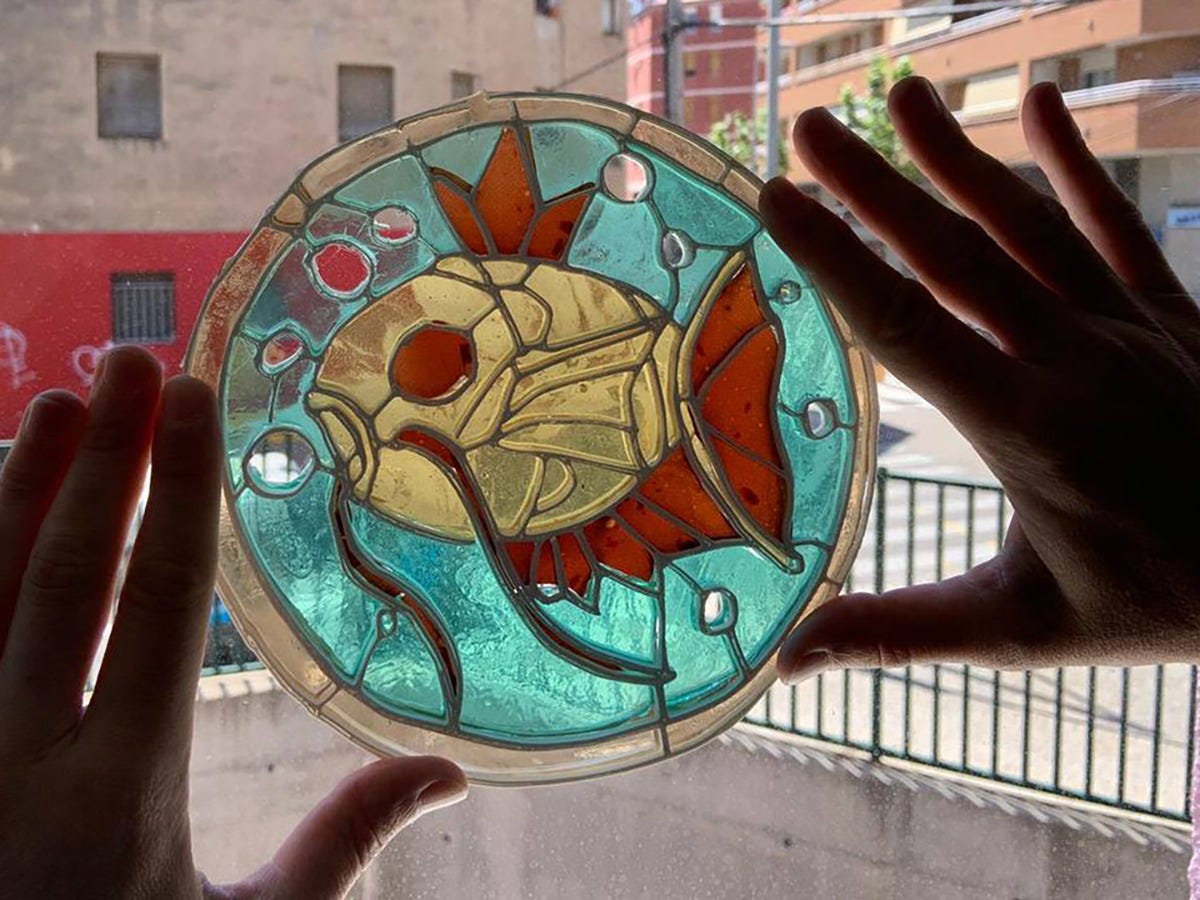
Dale: Sam, maybe you could give us the framework around Universal Design for Learning.
Sam: All of our are working on applying Universal Design for Learning (UDL) to our practice and research. UDL a learning design framework that plans for and designs for learner variability and barriers that exist in the learning environment from the beginning rather than retrofitting it later.
So if that variability is in how people perceive information, we plan for that. We know there’s variability in how people build their skills and demonstrate understanding, so we don’t assume that everybody’s going to be able to manipulate information the same way or make sense of it in the same way or show that they’re understanding the concepts in a makerspace or anywhere, all through the same means.
We provide options for how people can build and demonstrate their understanding. Then, in terms of motivation, we think about how people in makerspaces might want to jump right in and use something, or they may want to observe someone else using it first. They may be highly motivated by novelty. Or they might find novelty problematic and prefer something more predictable.
So it’s a framework that pulls from evidence in the learning sciences, and a lot of practitioner work over many decades now, to design in a thoughtful way the variability that comes about in any learning environment.
Dale: Is it new to connect maker education and universal design for learning?
Xavi: No, the underlying idea is not new. Maker education has long sought to broaden access to methodologies, tools, technologies and spaces. The mindset is not new either. What is new is how we can use the UDL framework to apply that mindset more systematically across different contexts.
It is important to understand the context in which learning takes place. Is it an independent makerspace for adults, or a makerspace within a school where teachers lead the learning process? We also need to ask how the UDL framework can be applied to different groups of learners.
Dale: The paper emphasizes creativity and creative learning but universal design for learning could be applied to math or any subject just as maker education could be applied to a lot of different areas like physics. Do you focus on creative learning?
Kim: I see creativity and creative problem-solving as processes and skills that can be learned and applied to many subjects and areas. The possibilities to engage, learn, and thrive in a makerspace environment and in maker education are greatly enhanced through UDL. In other words, applying the UDL framework broadens who succeeds in learning creative problem-solving skills, and thereby expands who has access to creative learning and creative work opportunities.
Dale: My original thing going back 10 or 15 years was, “Well, why isn’t this more available to kids?” We could reach kids who are struggling in school that don’t necessarily do well academically; it doesn’t bring out the best in them. But when we give them something different to do or give them access to a makerspace, we begin to see that it brings out the best in them.
Kim: People walk in differently to a makerspace than they do a traditional classroom, thrive in some contexts and struggle in others. Sam and I at CAST wanted to explore how the UDL framework anticipates this and provides guidance that supports all learners to thrive.
We pursued funding that could allow us to look at how this is happening in makerspaces and how it addresses learner variability in this space. CAST was focused mostly on education research in public schools, and in my mind, this is a very hard place to move the dial, given the larger forces at work. I’d be very interested, Sam, what you feel, has shifted given this article and our focus on this sector of learning.
Sam: The informal spaces, our makerspace, which was really co-designed with residents in affordable housing, aligned with both fewer rules about how learning should look, and more of a natural inclination towards learning that’s social and collaborative.
Everyone’s work here could speak to this but it gets at the idea that in the US the creative people or the people who have resources – social capital, income – “perceived as abled” in our society, they go and get to create things, and then they tell people who have fewer of those things to go and implement someone else’s ideas. Go do the thing that I invented.
That sets us up very poorly for people being able to solve their own problems, especially as people who are disproportionately impacted with very complex problems tend to be at the bottom of the pyramid. Like the impact of climate change is fundamentally harming people who are lower income much more than people who are higher income. People with disabilities are deeply impacted by the decisions that get made in medicine and healthcare but they’re very often not the problem-solvers or the creators of those solutions. So a big component of why is linking makerspaces where the rules are not so defined, or in the case of Barcelona, redefine the rules in education and also redefine the sort of hierarchy of who gets to invent things and who gets to deal with other people’s inventions.
Dale: Santi, would you talk more about Barcelona.
Santi: We have been working for a lot of years on how we can make maker education a little bit more relevant here in Barcelona or Catalonia. Together with Xavi, we have been working a lot, and we are lucky to have maker culture at least here. In Spain, things come a little bit later than in the United States.
I remember some time ago, when we were approaching schools, public schools, public institutions, trying to explain the benefits of incorporating makerspaces, for example, in schools. They didn’t know too much about the potential of these spaces. We were lucky to start some projects where we could start approaching it in a more systematic way and to see how this can be a nice approach for teachers, to work in a different way in the schools.
We were talking about creativity and in makerspaces. There is evidence that these skills can be cultivated in a way. There are people that are creative, and some other ones are not. When you see kids working in the makerspace in the schools, you can see how there’s other ways to work in a creative way and this can be cultivated.
Dale: Stephanie, I wanted to hear from you. How did you come to write this paper and did you work mainly on the Community Shop Class section?
Stephanie: One of two of the examples that I contributed was around the work that Community Shop Class has been leading here in Sacramento. I’m an active member of Community Shop Class and have been on the advisory board for that particular space. They have a really unique model in terms of having always prioritized and centered inclusion, particularly for the neurodiverse community and other marginalized communities here in Sacramento.
The other example is the Tikkun Olam Makers (TOM) case study as well. That model recognizes that need-knowers are critical to really enabling communities to come together. How they co-design solutions to challenges in assistive technology is unique. That is certainly scalable and replicable across communities.
There are two primary things in this work. One is recognizing that we’re at an inflection point now. I think we’ve all talked about it – where technology is changing. AI is not the only thing that’s going to change education and our society as a whole; there’s a lot of other things that are happening. But what we know is that creativity is going to be really core to ensuring that our communities stay vibrant and resilient. Also, learners of all ages have the ability to come together and solve problems that they have.
Creativity can really be supported by the UDL framework when combined with maker education and maker-centered learning. That’s one aspect of the work that I think is really valuable and can be leveraged by communities. I would say that the case studies that we shared, those communities or those makerspaces, are leveraging UDL. There’s probably a whole host of other really great examples out there of spaces and organizations that are leveraging concepts or key aspects of UDL but may not even know it.
Dale: What does this practically mean?
Here’s a UDL framework in a makerspace. What am I doing as an organizer of a makerspace or a teacher in that makerspace, what should I be doing? One of the challenges of maker education is that so much falls on the teacher to do all this adaptation and figure out that different kids need different things. It can be overwhelming. It’s much easier to say, “Here’s the standard, and I’m doing the same for everybody,” than it is to say, using your word variability, that I’m introducing this variability in the learning experiences of a group of students.
Kim: I’m going to be doing a lightning talk on this at Fab26 using a very simple “light-up plushies with circuits” lesson. How do you leverage UDL with something like that?
The thing that first comes to mind that teachers are assured of is that UDL is not a checklist. Don’t be overwhelmed. Use the UDL design process to 1) think about your context and lesson goals, 2) anticipate barriers in the goals, lesson design, or learning environment, and 3) use the UDL Guidelines to design in one or two options that reduce barriers and make the lesson more flexible. This improves the experience for you as a teacher and for the learners. I made a spreadsheet to start thinking about where the areas are for improving the light-up plushie lesson design, and I draw from these each time I teach the lesson, improving it incrementally For example, pair verbal instruction with a step-by-step handout, then make it available digitally for those who need translation or screen reader access, and finally, make or find a brief how-to video highlighting critical features of the process and offering variations based on goals (e.g. hand sewing versus fabric glue, etc.).
Sam: Kim, talk a little bit about some of the work you’ve done around high ceilings, low floors, because you really brought that to the makerspace work. It’s such a powerful example of people being able to participate regardless of how much expertise they had coming in.
Kim: We did a bunch of fun activities at the makerspace that Sam and I started with the community at the Stamford Affordable Housing Community. One of my favorite examples is with the Finch robots (designed by Birdbrain Technologies) because they are such a wonderful, friendly device and platform to play with and to have the kids and the grownups learn with.
We had five-year-olds programming and guiding these robots, and older youth and grownups peeking behind the hood and understanding a little bit more about how to code. That’s an example of the low floor, high ceiling in the materials or topic matters you choose.
We have also made community quilts, where we started with just thinking about a square and composition on a square, then looked at the composition of the quilt and incorporated sewing machines into the mix. Multi-generational making is a wonderful constraint for needing to think about everybody’s experience. Here’s some glue, here’s a needle and thread. Engage them depending on where they’re at.
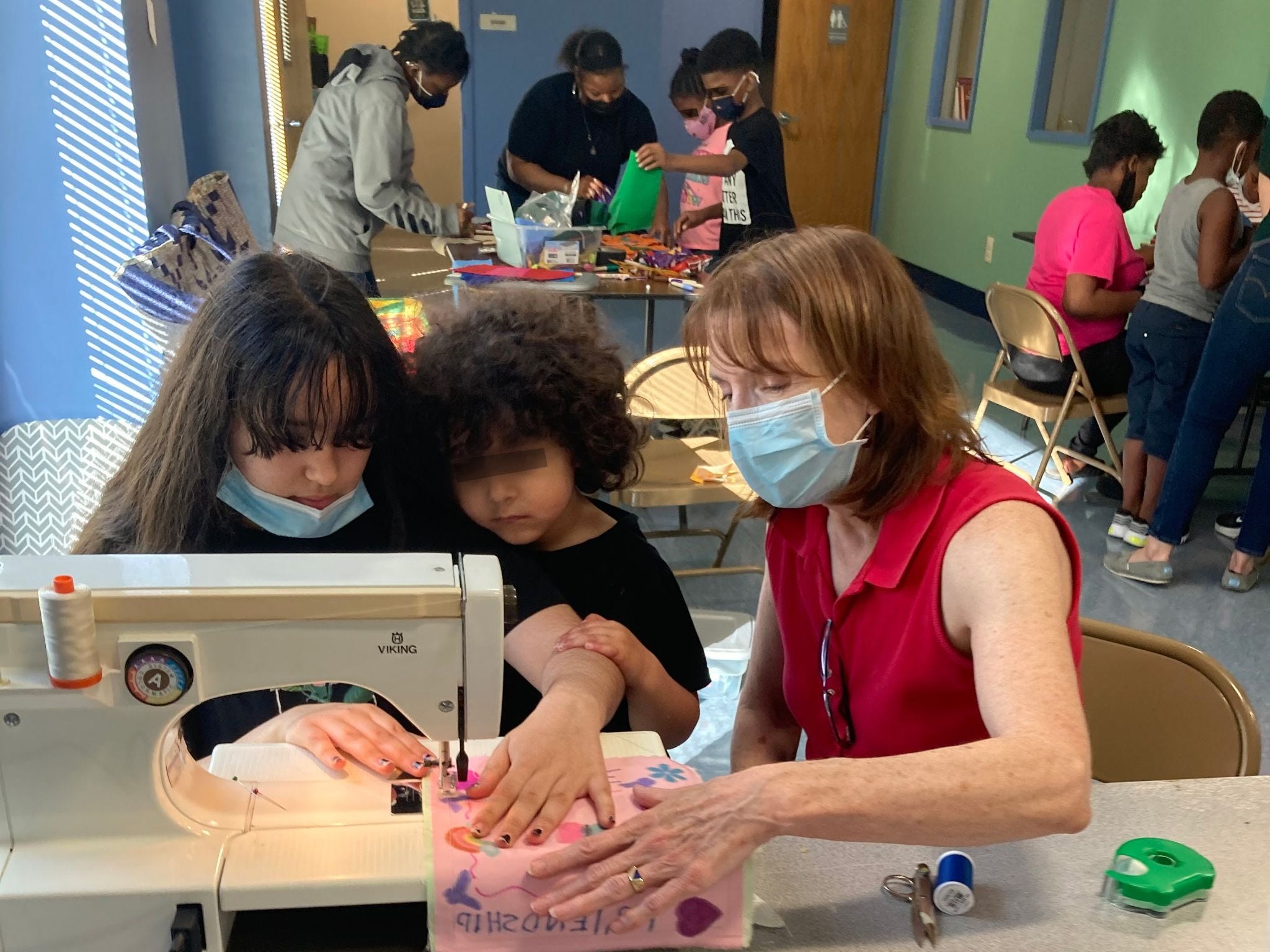
In this photo, you’re seeing the sewing day for the quilt. You can see the teen, a grown-up, and a four or five year old looking on. But my favorite part is what’s going on in the background, where everybody’s engaged and really in every aspect of this project.
Dale: That picture also shows me that I’ve been using the phrase, makerspaces are social learning environments. And there’s actually an editorial in today’s New York Times on silent classrooms (The High Cost of Silent Classrooms) where all the kids are at computers solving problems. Nobody knows what’s going on in the kid’s mind or in the teacher’s mind even.
I’ve always felt makerspaces have this nice little buzz to them with kids doing stuff in groups. It’s not silent. It has a buzz.
Kim: Here are a few pictures that Stephanie contributed.
Dale: That’s Community Shop Class?
Stephanie: Yes.
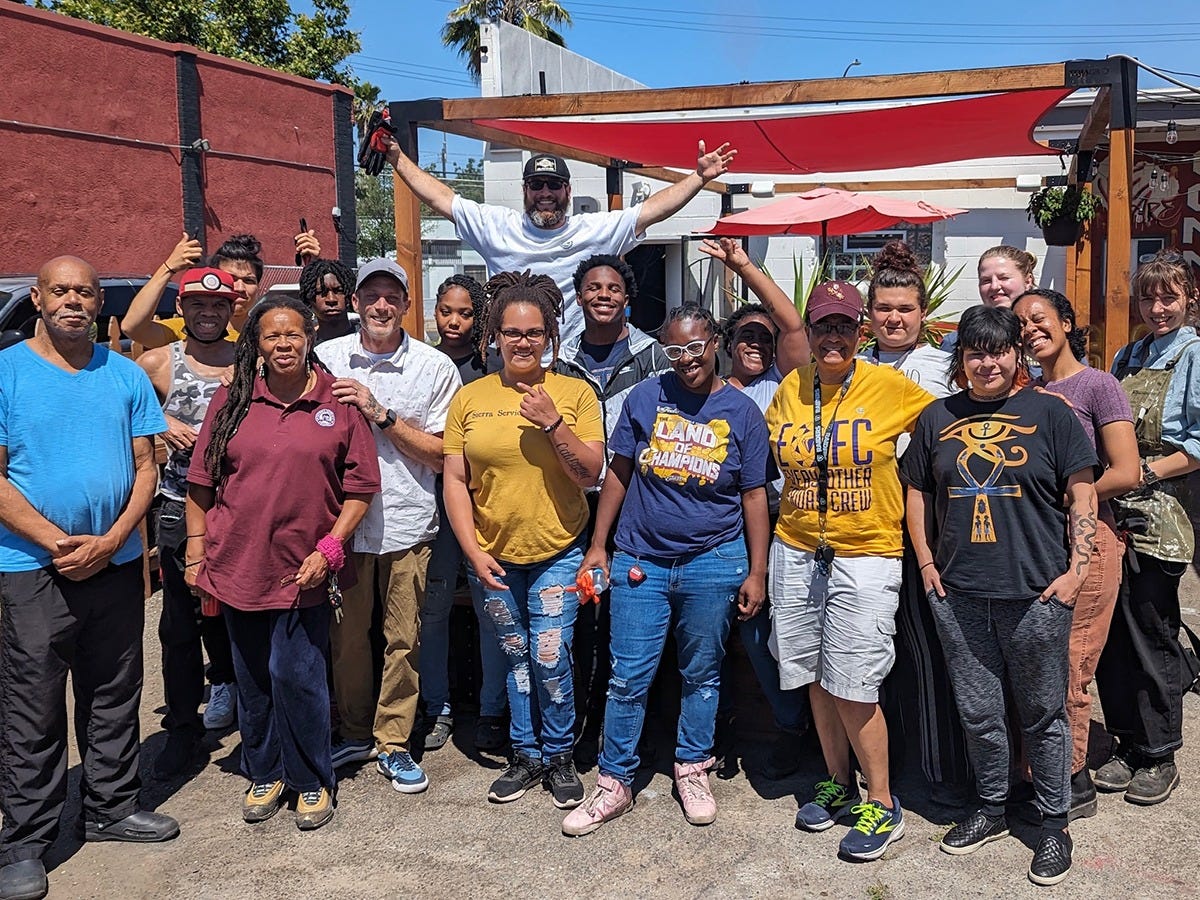
Stephanie: There’s the tiny home in the background, and the crew here.
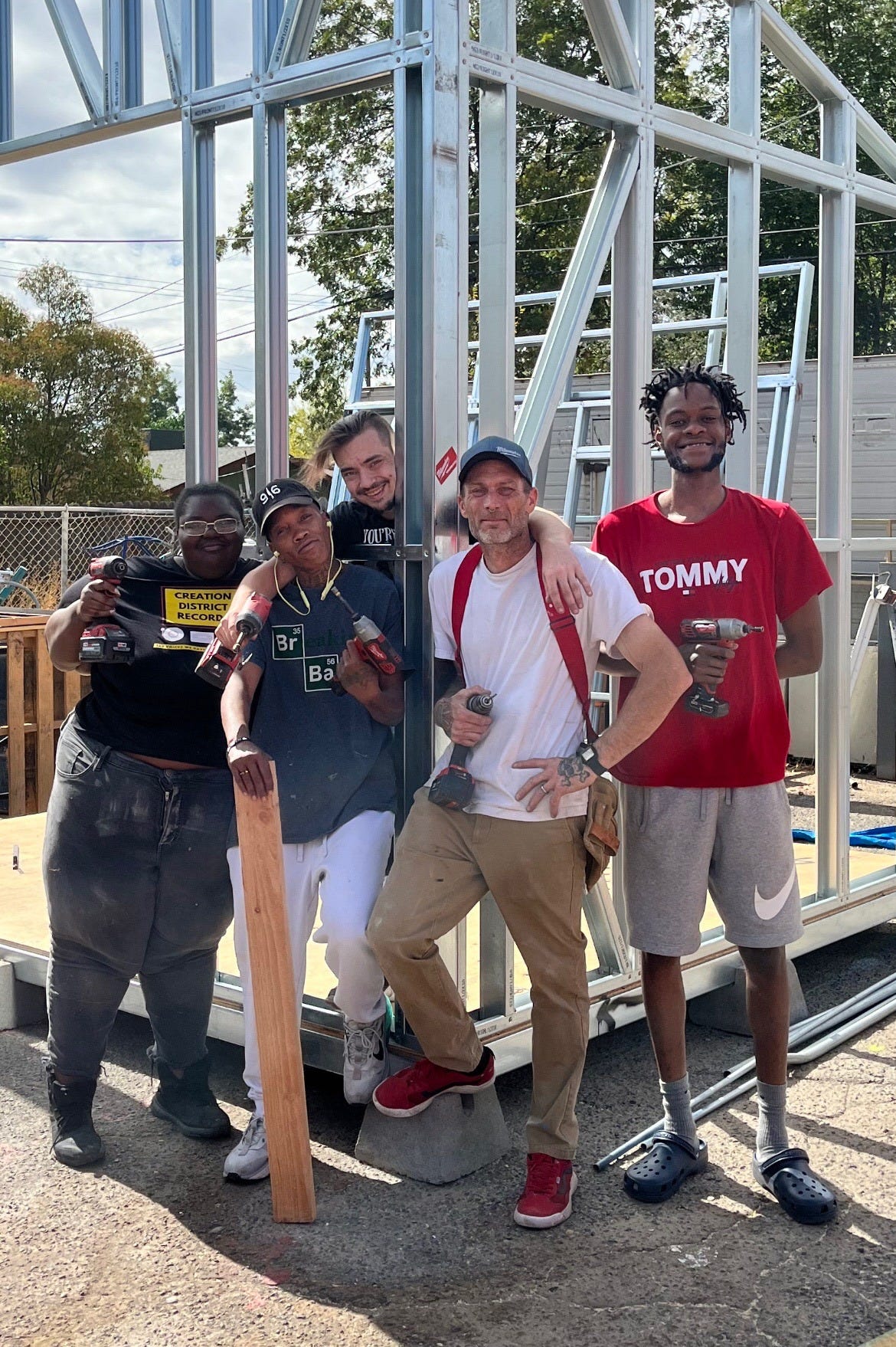
Kim: Then this is using biomaterials to redesign shoe insoles, and then the teachers learning all about that. Santi?
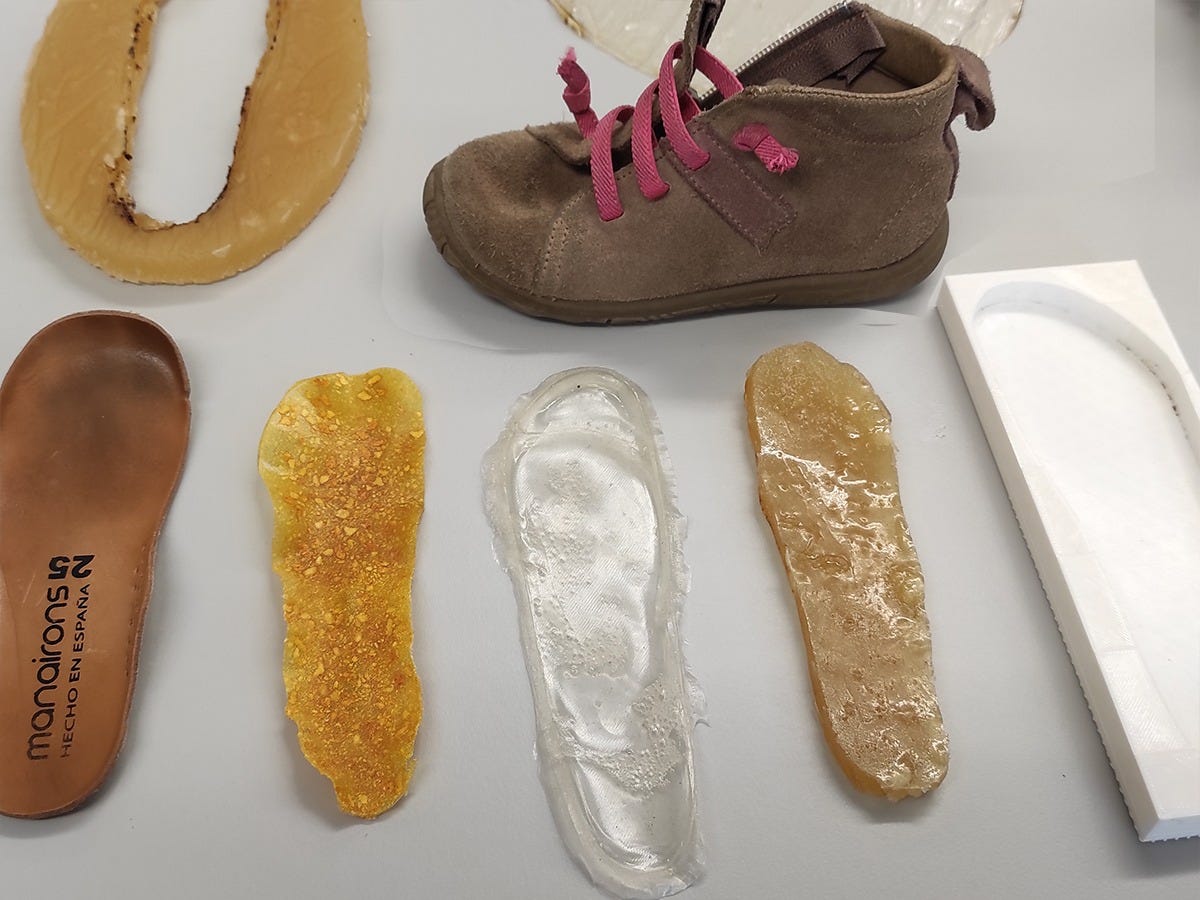
Santi:These were projects of Remix the School, plus then the DTecla. These are some of the training sessions with the teachers about biomaterials. It was a surprise for us because we find this topic makes the maker maker movement real accessible to teachers.
So we didn’t think that biomaterials or biofabrication would be the entrance door of the whole of this community. We tried so many things before – 3D printing, everything that you can imagine. We thought this is gonna be super useful for them and it will be very welcoming.
It’s something that everybody can do with the minimum ingredients that you can find everywhere. You can connect with communities because you can use leftovers or whatever. They can do it in the kitchen with the kids. And then little by little, you could incorporate as much technology as you want if it’s needed.
With biomaterials you can also go into the textiles aspect, so you can go further and further in that.
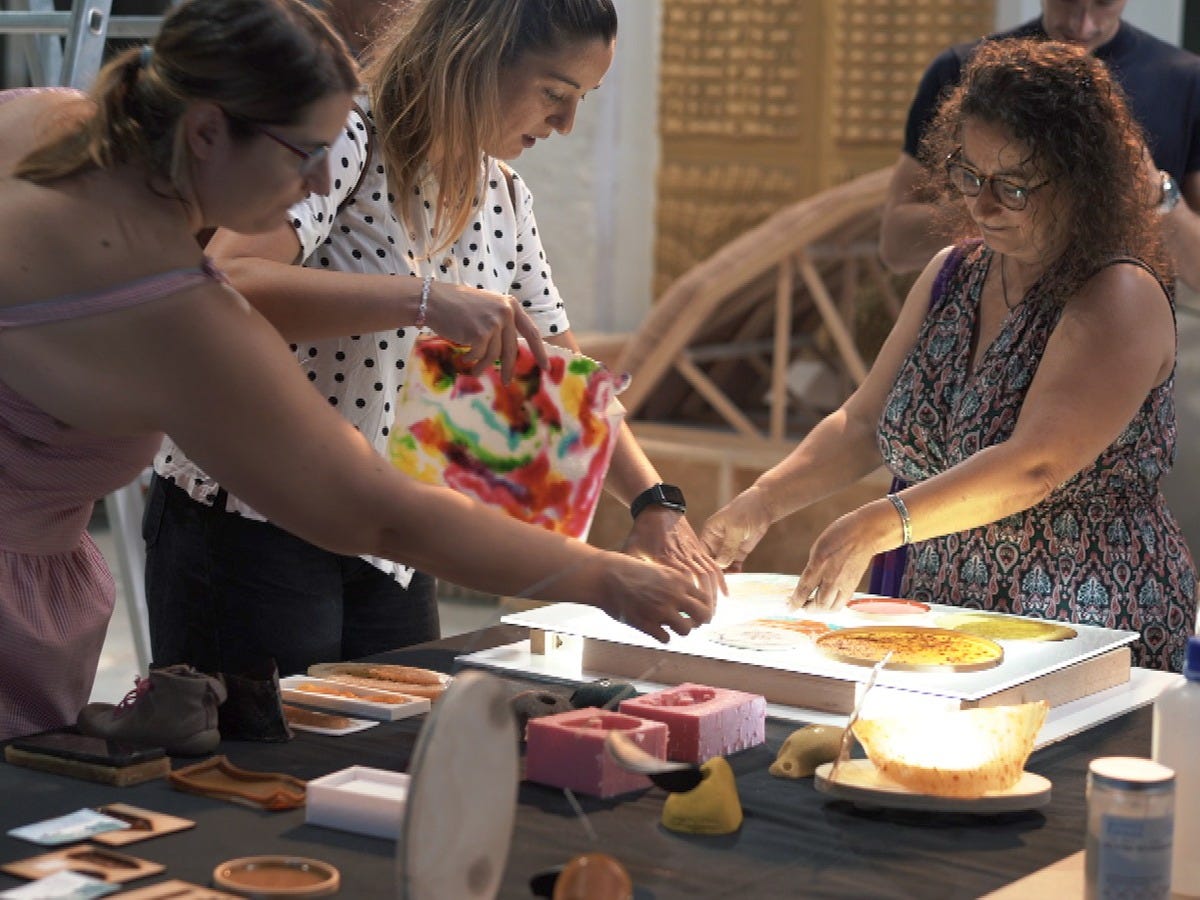
Kim: I love the Remix the School project. They use the community’s byproducts. They would go around and collect the coffee grounds from cafes and make these gorgeous products out of them.
Xavi: I want to return to a key message about UDL: it is not a checklist. It is a tool that helps teachers ask how they can best support the students in front of them, especially in formal education.
I remember that ten years ago, teachers would come to the lab with Santi and say, “You are very creative because you have all these machines.” Over the years, many schools in Catalonia have acquired these machines and created makerspaces or Fab Labs. Now, however, teachers are asking, “What can we actually do with them?”
Starting with biomaterials was particularly effective because it offered teachers a safe and accessible first experience. There is room for experimentation: the material may not behave exactly as expected, but that is part of the learning process. Teachers feel comfortable working with these materials, and this becomes a first step towards understanding the maker mindset. Once they understand that mindset, they begin to ask what they can do with the technologies and machines available to them.
Designing for students is equally important. How can we create engaging learning experiences? In one case, a class was studying ancient Egypt, and the teachers proposed creating 3D models of objects from that period.
The first step, therefore, is to give teachers a positive and safe experience. The next is to help them design activities for their students and introduce meaningful challenges, because well-designed challenges can foster creativity and engagement. Once teachers have designed the experience and the students are engaged, they can begin designing with the students.
Students then explore materials, develop solutions using these technologies and approaches, and collaborate with one another. These challenges become especially powerful when they are connected to the local community. With biomaterials, for example, a school might collaborate with a nearby coffee shop and reuse its coffee grounds. Students can ask questions not only of their teacher, but also of experts in the community. This can create particularly valuable community-building and learning experiences.
Dale: Just on the community side, you mentioned that there are a lot of skills out in the community around the school but schools typically don’t make a connection to the people that do those things or invite them in.
When you do ask them in, they come in not as teachers, but as people who do things and they can show how they do things and maybe talk about how they learned to do it and what they’re, what they do every day. It’s a valuable role.
—
So I mentioned the Times article and I just want to throw out two things which may not exactly align with the discussion of your paper. One is that since COVID at least in America, education has seemed to take several steps backwards. It’s less concerned with innovation, and the system is just trying to survive and hold on. The second is that we’re seeing a backlash against technology in the classroom.
I would say that the way that EdTech framed technology has made it a rather passive experience for kids. As well-intentioned as it may have been, and all its promise of one-to-one learning, et cetera, has created an over-reliance on technology in the classroom without necessarily producing better results.
I’ve felt like the maker movement or maker education can reframe our relationship with technology as tools that we use in a variety of ways to express ourselves, to create things, to do things, not just consume things. One of the knocks on EdTech is that they turn the student into a consumer of education, not a creator of their own learning.
I don’t know if either of you want to disagree or go in the same direction.
Stephanie: I’d like to build off of what you shared, Dale, because I’ve always thought that the sort of the most exciting and most impactful examples of how technology and tools and equipment can make learning more engaging is when they are in service of that learning. It’s less of a focus around the technology or the equipment itself, which I feel often tends to happen. Oftentimes when people first heard of makerspaces or maker education, if they didn’t know that much about it, they’re like, “Oh, it’s just 3D printing and stuff.”
They’d glom onto a particular technology that maybe was like one that you heard was often found in a space or associated with maker education. The best examples of maker education are when those tools and technologies and equipment are in service of learning.
Dale: Sure. But what the system considers learning is often just aligned with subject matter, not process.
And so that’s why I feel this regression in education and its focus on, math, reading and history or whatever, taught in a very conventional way doesn’t motivate kids to learn.
Kim: I wonder if one of the silver linings of the AI debate is going to be learning how to use technology as a tool rather than trying to consume massive amounts of information.
Recently, I was organizing my thoughts around a large number of topics for projects I’m incubating. I asked AI, “How would you mind map this?” It became a fruitful back and forth “conversation” around the organization, and reorganization, of the topics. It got really interesting when I added in “how do these relate to my interests/loves for (fill in the blanks, here)? Wow. From where “we” landed, I was able to brainstorm project ideas, and came up with some amazing directions to pursue.
Dale: It involves interaction and feedback. That’s what learning looks like.
I read an article recently about the importance of agency in using AI, that it can really foster agency, just as the internet itself did. You could find out all kinds of things. But today, just sitting a kid at a computer and telling them to do things, if they’re not motivated and have the mindset to take that on as a challenge, they’ll be off doing something else that is entertaining them instead of educating them.
Sam: Can I just add an example to that? I think it gets back to why we focused on creating more equitable access to creative learning and creative work. When you get back to thinking about education technology, a lot of the people who’ve been producing the technologies are thinking, “Oh, I’m gonna go and solve someone’s problems and drop this thing on them, and it’s gonna fix the thing.”
It’s like being in the White House saying, “Oh, okay, I’m, here’s the robot teacher” rather than saying, “I’m gonna give people the capacity to pull this thing in to solve their own problems.” Things could be very different if more people are in a place where they’re like, “I have agency to be creative.
I use that creativity to pull in what I need,” right? To think about what’s necessary, to turn to someone else who has a different skill set than me and work with them. People are much less inclined to take a technology and say, “Oh, this technology’s gonna do it for me.” They’re gonna say, “I’m gonna take this technology because the thing that I have that’s more powerful than the technology is my capacity to think, be creative, and pull together others.”
Dale: If they realize that.
Sam: If they realize that. But I think that’s the point of our work. What we’re trying to say is more people need access to the opportunity.
Dale: Let me just ask, and maybe just as a way to wrap things up. Would each of you just give a closing thought either on your paper, your work or what you’re working on next.
Santi: I was thinking that makerspaces in the schools are a nice opportunity for students to explore new ways to relate and collaborate. It’s difficult for that to happen in another environment in school.
So this is why when we start a makerspace or a Fab Lab into the school, we always say in here you can explore different relationships of student and teacher. It’s a way to change behavior day to day.
At the Fab Lab Barcelona, we are lucky to work on so many projects at the same time. But one that really motivates me is something that I’m exploring together with my students. That is a kind of tool for critical reflection – how do we use AI in the maker projects in a kind of transparent way. It’s basically a tool for inviting the students to reflect on how they use AI during the whole process.
So not just in the formalization itself but also in the research part, in the coding part, in the making part. How much do they think they use it? How do you collaborate with AI?
Dale: Good. Sam, how about you?
Sam: What I’m working on a lot is what are the ways in which we can get people into fields that impact them and their own communities. This acknowledges that they need exposure and they need opportunities to engage with the field in order to be able to have meaningful roles.
And what we’re trying to do is put in front of various fields the idea of if you’re really gonna think about nothing happens without us, nothing is for us without us, unless we’re part of creating it. You’ve gotta think differently about who gets access to these areas of emerging industry, these areas of emerging STEM research.
And we’ve kept those whether it’s through linguistic means or how to gate keep communities. We’ve kept so many people out who are so impacted by the outcomes whether that’s medical devices, whether that’s genetic research, whatever it is. And so I’m trying hard to work on, can we come up with a different way of thinking about how to get people into industries that works on a much longer time line, how can we create more opportunities for exposure, for thinking about what big problems people are solving, and starting to take these out of these ivory tower institutions,
Xavi: In my case, through DTecla, we continue to work closely with teachers in public primary schools. Our focus is on supporting them so that they become increasingly confident and autonomous in designing and implementing these learning experiences in their own schools.
Kim: So thinking about opening up and widening creative problem-solving to a broader audience, that’s what the paper is about. For me, given our project with the affordable housing community and informal learning spaces, I would like to do more in multi-generational making and learning, and thinking about what opportunities open up and for whom.
And I’m working at the intersection of textiles and technology, which pulls in girls and women. It taps into the wisdom of seniors, and it really helps us in informal spaces redefine what constitutes learning. It’s a really exciting conversation to be in. I’m working at Artisans’ Asylum spearheading an open access program for them and looking at how we’re working with the local community – the local first, then global.
Dale: Steph, we give you the last word.
Stephanie: I’ll keep it short and sweet, but I’ve been working on a new project that I think in a lot of ways builds off of and is very relevant to the work we did around this paper around universal design for learning.
I’m very interested in developing a better understanding of the ways in which makerspaces serve as infrastructure for community resilience. I think I referenced resilience at a couple of different points in our conversation, and I think in the way that you think about institutions and communities like libraries or the fire department or EMS services.
No one would argue that communities need those. So I’d love to get us to a place where all communities recognize that makerspaces are a critical part of our infrastructure. I’d love to think more about the critical role that universal design for learning can play in ensuring that those spaces are accessible to everyone, and that they are nurturing and fostering creativity in everyone.
Dale: Thank you, everybody.
Sam: Just to add, we do have for theBayview Makes makerspace, a whole playbook. I’m just gonna share that with you because it’s all freely available with videos, information, and tips on how to co-create a makerspace program with your community.