

Talking Shop with NorCal Maker Educators
Getting to know maker educators in different kinds of makerspaces

One of the strengths of maker movement is the range of different places where you can find makerspaces — museums and science centers, libraries, community colleges and universities, and in K-12 schools. There are also makerspaces rooted in neighborhoods, like Community Shop Class in West Sacramento. By no means are makerspaces everywhere they need to be, but they are found in diverse settings, bringing people together to make things.
That was clear from the presentation and the participants at the NorCal Maker Educator Collaboratory meeting last month in Sacramento. The meeting was organized by Stephanie Santoso of MakerUSA, Zack Dowell of Folsom Lake College, and John Pellman of Capital College and Career Academy.
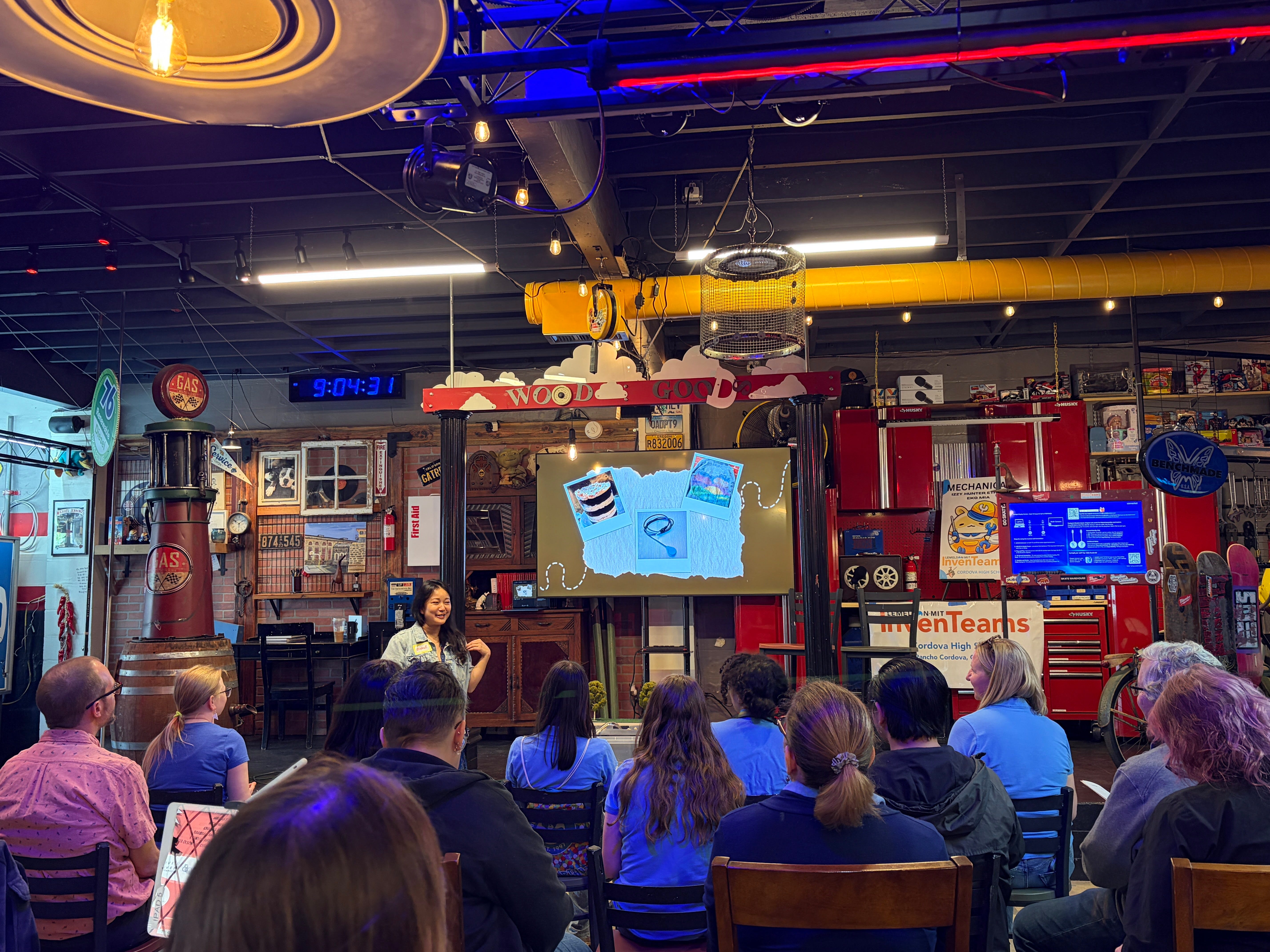
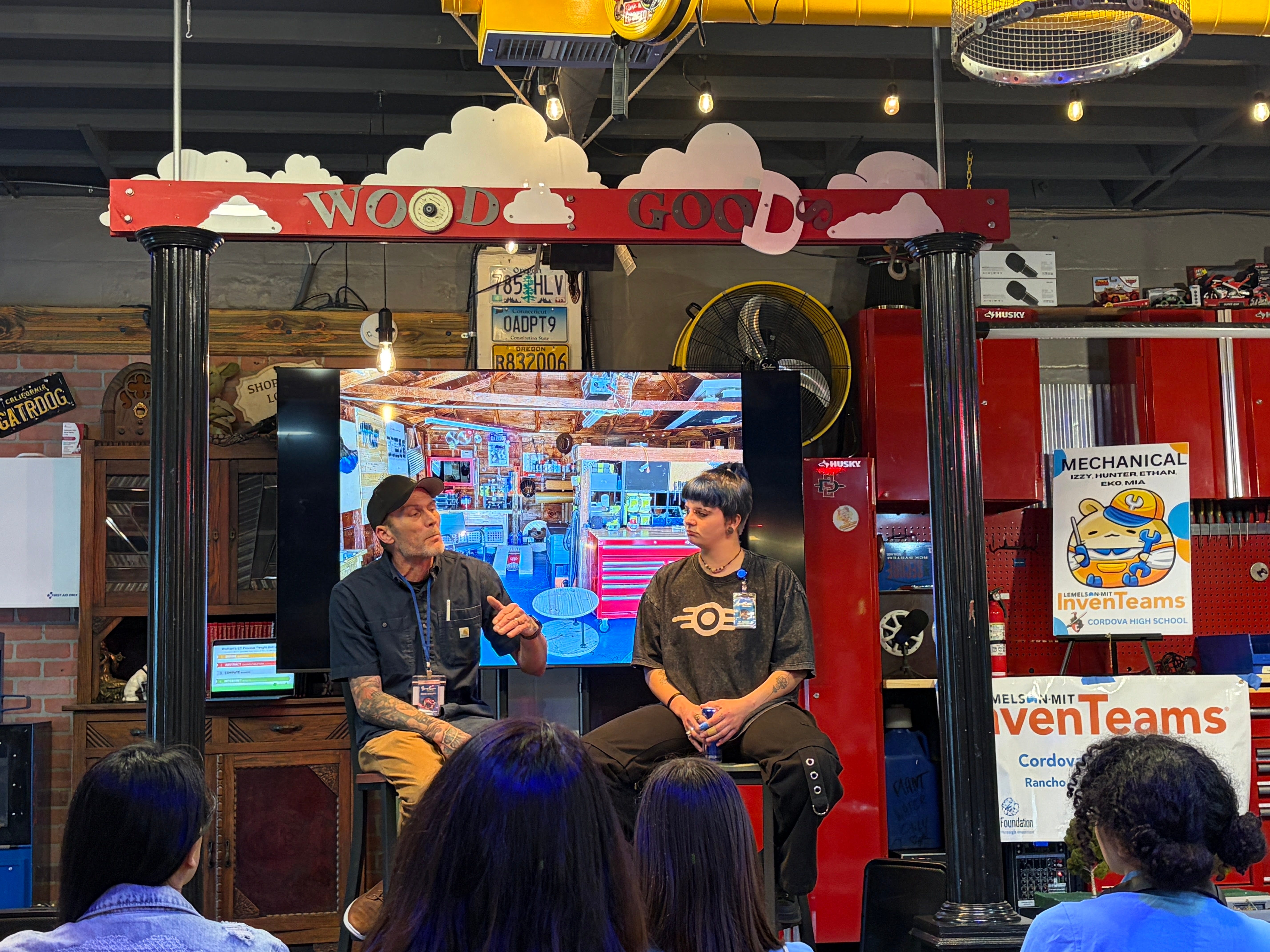
First, a shout out to Chad Orcut for hosting the event at Community Shop Class, whose space is truly one of a kind. Chad who calls himself “Head Janitor” spoke to the group, along with AJ Rossell, the Shop Coordinator. I wish I had recorded Chad’s talk because he’s a terrific person. He said that he had created “The ADHD Inventor’s Club” in his garage at home. He had an idea for a toy — a combination of skateboard and cornhole.
A voice inside my head said: “You’re not smart enough to do that. You don’t read! You barely graduated from high school. You can’t do these things. You’re not a maker; you’re not a teacher; you’re not an educator; you’re not a community advocate.” But the truth is I am all of them. The reason I can stand here and tell you that is that I had an idea in my head and I actually built it.
Chad pointed to a prototype of the toy he made. That led to the idea of him getting a larger space and building it out for others to make things, and that’s the story behind Community Shop Class.
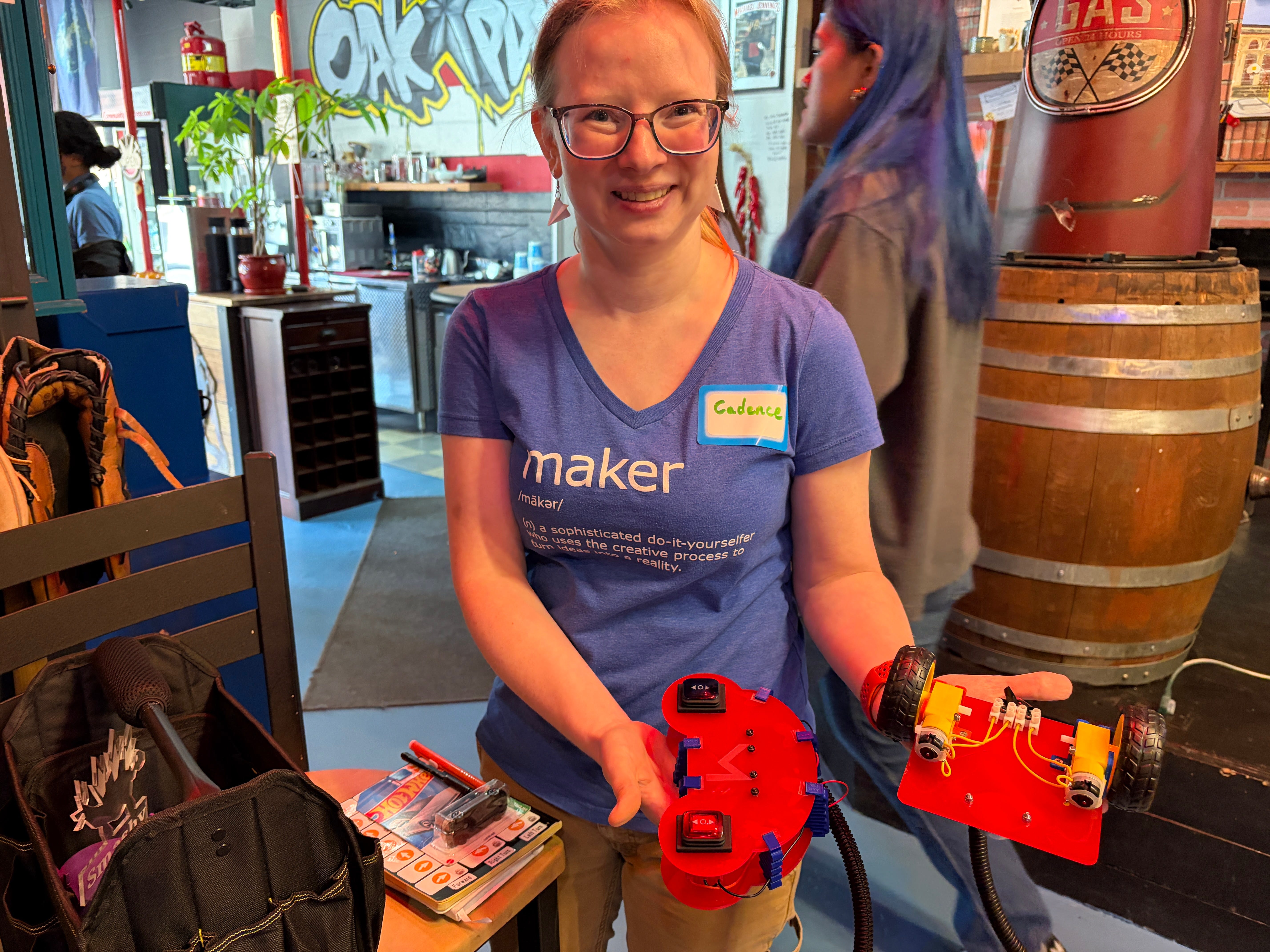
Cadence Johnson of the Museum of Science and Curiosity (MOSAC) wore a t-shirt with a very nice definition of “maker.”
Maker - a sophisticated do-it-yourselfer who uses the creative process to turn ideas into reality.
At the end of the event, I sat down with three of the NorCal Maker Educators to learn more about what they do.
Rachel Okazaki, Kraus Center for Innovation at Foothill College
John Pellman, Capital College and Career Academy
Trina Camping, Woodland Public Library
You can listen to a recording of our conversation or read the interview below.
Talking Shop with Rachel, John and Trina
Dale: I’m here at Community Shop Class with John, Rachel, and Trina, and we’ve been part of a NorCal makers meetup here. It’s been fantastic. I just get so inspired to hear the stories of real world work that’s happening that most people don’t know about, and that’s why I wanted to get a few minutes with each of you.
Let’s start with Rachel, if you don’t mind. Rachel, can you just give us a little bit of background on yourself? And where you work in a makerspace?
Rachel: Sure, yeah. So I’m Rachel Okazaki. I work at Foothill College at Kraus Center for Innovation as a makerspace coordinator. I also have a background in pediatric physical therapy and I spent a couple years baking at my home-based bakery, the Hangry Moose .
Dale: That’s great. And what are you wearing there?
Rachel: Oh, I’m wearing my ongoing project. I’ve been getting into a kind of hand embroidery called sashiko, and so I’ve been working on my landscape jacket. I have a denim jacket that I thrifted and just whenever I have time I add more colors and more layers and decide it’s finally at the point to wear it.
But I still am gonna add more probably over the entire jacket.
Dale: One of the things you talked about today was just that we have these different facets of ourselves. They are reflected in those different things you already mentioned.
Rachel: Yeah, definitely. And I’ve noticed that my time in the Makerspace, the different identities like that I have and the different things that I, characteristics I guess I should say, that I wanna become.
So the creative side shows up in all the areas. That I work in. The kind of curiosity, the innovation. One of the maker mindsets that I always go for is the celebrating failure, because I think the failure has such a negative connotation. But in all the areas you have to try to see if something works.
And instead of getting down on yourself, it’s okay, I found out what’s not gonna work. So let’s go for the next thing.
Dale: John, tell us where you work.
John: Absolutely. So I work for a school called Capital College and Career Academy. We are an independent charter school in Sacramento.
We describe ourselves as the the premier school for hands-on learning in the Sacramento area. All of our curriculum, whether it’s English, math, science, social science, we have hands-on Learning. But in addition to that, we also offer a building trades program, advanced manufacturing, computer science, entrepreneurship. I am a deep believer in hands-on learning can be not only engaging, not only fun, but also very rigorous.
Dale: So why don’t we have more hands-on education?
John: As you and I had the opportunity to talk earlier there’s a lot of reasons in the way that our public education system is set up. And I’m not here to bash public education, at least not right now. But it’s really not designed to facilitate hands-on learning. It’s designed in essence to send kids to college. And sending kids to college is about academic standards and test scores, and there’s a place for that.
There’s absolutely a place for that in our education. But if we really wanna think about adolescent development, if we really want to think about what gets a kid inspired and happy in school, it is not standards and it is not test scores. It is doing things with your hands. It is the interaction that happens when you do things with your hands.
And I would like to rename the failure as the steps to success. That every time you do something wrong, you start to understand better how to do something right. And our schools are just not set up to be that way. Sadly, and there’s lots of reasons why, which is probably the subject for a book or a long podcast.
Dale: Yeah, that’s true. We’ll maybe follow up with that. Let’s go to Trina. And Trina is a librarian, but not just a librarian, if I might say that.
Trina: My name is Trina. I’m a makerspace librarian in Woodland, California. And we have been open almost 10 years and I really love offering resources and supports and opportunities for people in the community who wouldn’t normally get them.
People are like, why are libraries in the makerspace now? Libraries have always been about providing access, whether it was a printed book, whether it was the computers in the 80. Internet in the nineties, and this is just another facet of that. Not every kid has a 3D printer in their bedroom.
So I really love bringing kids in and showing them that they can do things that they have no idea that exists or that they don’t think they’re capable of.
Dale: Trina, that’s not all you do though, at the library. You take making out into the community and work on makerspace in other locations?
Trina: Yes.
I helped build and design our makerspace about 12 years ago we started and so we’ve been open longer than a lot of other makerspace in the area, and I get a lot of requests from people saying, Hey, can you come check out my space? I need help. I need to know how, what to buy. I’ve had a community college from Australia come and see our space and ask me questions about how to build one.
There’s several schools in our district and our neighboring districts. So there have been across the US people that have come to see how to do a makerspace and to be inspired by what we’ve built.
Dale: John, when you said, schools are designed for the kids going to four year colleges who are they missing in that school population?
John: Who are they missing? Statistically and this statistic has not really changed. It varied maybe a little bit here and there, but statistically we’re looking at about 30 to 35% of high school graduates will finish a four-year degree.
And when you look at that data, that doesn’t account for the kids who drop out. And that doesn’t account for the young people who complete a four year degree. And lo and behold, realized that the four year degree that they completed was not the thing that they actually had wanted to do once they graduated.
So I, as an educator, and it’s one of the reasons why I’m a part of a founding member of this charter school, Capital College and Career Academy, asked myself the question, what are we doing for the other 65% of kids who are not going to college? I’m happy to say that I think that there is a bit of a sea change in our orientation towards post-secondary education. And there’s things written about what’s called the tool belt generation. And this particular, in particular boys, but not only boys, some girls as well, but this particular generation of young people who are starting to say maybe a hundred thousand dollars worth of college debt is not necessarily worth it.
Maybe I’m not really engaged by sitting in a lecture hall and no disrespect to professors in lecture halls. I have three degrees and I would happily go back to post-secondary if I could. But the fact of the matter is that the majority of the school age population who go through our schools are not going to graduate from college, let alone go.
And at some point in time, we in the public education sphere have to reckon with that statistic and ask ourselves the question, how are we spending these kids’ times in the classroom to really prepare them for that moment when they leave formal education?
Dale: One of the post-secondary paths is community college and they play a really important role. I wish kids were better prepared. Some of that 65% are going to go to community college. The question is, are they prepared to go there? Do they know what they want from it? And, can they access it? So you must see that at Foothill.
Rachel: I’ve noticed there are more and more students that for a variety of reasons are coming to community college. We’ve definitely had an increase now that after COVID and we’re doing everything online, people are looking for more in-person. And I’ve been learning about what we offer for like our programming and the resources on campus. Because it’s not just about the classes, it’s about what else makes coming in person worth it and some of the trade programs as well.
So between the two sister colleges that I work at, Foothill and De Anza, there’s probably more trade programs at the De Anza campus, a few at Foothill, but we do have the makerspace, which we find once students are in the space is when they’ll come back . And that’s been my push is to like, how do we get them here so they see what’s possible.
And it’s not even just for career or their classes, it’s like just for fun.
Dale: I was talking to someone from community college and I said, we recognize that kids who are in sports programs have a high sense of belonging at the school and they’re likely to stay in school. The other kids struggle with that, right? They, and they drop out. And I think if makerspaces can contribute to that sense that I’ve found a peer group, I found some interests that I can develop here. It’s more than the courses I take and the credits I accumulate.
Rachel: Absolutely, and I think another thing is we have a lot of introverts that come through and so I think it’s a good starting point that they can do something and be around people without having to say, commit to a bigger project or to go off campus somewhere to do club activities that they get to actually develop something and start building connections slowly in a safe space versus feeling I am gonna try to go to this big club meeting where I don’t know anyone and if I don’t feel welcome right away, I’m not gonna go back.
Dale: Trina, that was a phrase you used earlier that struck me. We talk about the kinds of things you find in a makerspace, but you said it has to be a safe space.
Trina: Yeah. When we started our day today, Chad spent a considerable amount of time, relatively, talking about how this is a safe place and talking about first aid kits and about, you can take a break and, we are not allowing this kind of behavior or a talk. And he just really focused on making it a safe space.
And it really hit home that you have to be safe in order to enjoy things, to learn things, you have to feel safe. And belonging is part of that. And having opportunities and being good at something is part of that ‘cause if you don’t feel like you belong, it’s not a safe place for you to be.
Dale: You also talked earlier about working with kids in continuation schools and other settings in non-traditional school.
Trina: Yeah. So we offer field trips for any school in the district, but we do have a couple of continuation schools that have brought their kids in. And the first one was pre COVID and they brought the kids in two afternoons a week. And the first time this group of 16 to 20 boys, mostly with ankle monitors and parole officers came in and they looked at me like, yeah, okay lady what do you think you’re gonna make us do today?
And I let them explore and I helped them develop things and one kid was like, oh, that’s a chess board, but we don’t have any chess pieces. And I was like we could make chess pieces, so we laser cut a full set of chess pieces. And just watching that spark was amazing. And after their three hours there, they all lined up at the door to thank me and shake my hand.
And that is one of the greatest privileges of my career.
Dale: That’s so wonderful. You don’t often quite know what it is that creates that reaction. I was thinking, Rachel, when you were talking like your jacket is something like, if someone walks in your makerspace and you started talking about how you embroidered that jacket and you’re still working on it, you’re not completely happy with it. It’s just such a personal thing, both it’s a form of expression, but it’s something that you have invested time in into. Education doesn’t often feel that personal to a lot of kids, right? It’s like something they’re trying to make me do that. The puppets and things that you were showing in your presentation, those invitations to play and personalize and create something that means something to you.
How many people are in your makerspace at a peak?
Rachel: Oh, you mean like participants that come in? I would say anywhere from 12 to 15 because they’re usually there for about an hour or two. Kind of rotating through .
Dale: John, maybe in closing, what’s your challenge in doing this in a larger school. How do you scale these kind of hands-on experiences to lots of kids.
John: Yeah, there are definitely challenges when you’re talking to do things at scale. If we talk about just California, I think there’s 6 million students in the California public school system. That’s a challenge. I think though, where if it’s ever going to change, it’s going to change with the mindset.
And Rachel said something earlier that if they just get in the makerspace. They enjoy it. We in public education, ‘cause public education is driven by adults as it should be. ‘cause we’re the ones who are responsible. We drive things for outcomes. We drive things to talk about what’s gonna happen in the future. What career are you going for? But that is run so counter to what adolescent development is all about. That ages, you know from that, when you go to kindergarten to the time you graduate, you don’t know what you want and how can you know what you want? Because you’re essentially in this sheltered environment, which is called school.
Until we start to align our educational programs with adolescent development that says exploration, exposure, collaboration, that those are the things that kids want and need to develop and to be healthy, strong adults. Until we get to that mindset, we’re gonna keep going down the rabbit hole of this program leads to college or this program will make you a plumber, or this program will make you be a doctor. It’s the mindset that needs to change. Yes, the scaling is an issue, but if we get the mindset then we’ll figure out the scaling piece.
Dale: That’s great. Is there anything I didn’t ask or is there anything you wanna say that I didn’t get to?
Rachel: I would just say I agree with that completely because if you think about the teachers, ‘cause we do a lot of professional development for teachers. So we can have 24 teachers who go back to 24 different classrooms that have however many students. So that impact definitely allows us to scale indirectly in that way.
But the teachers that are excited to introduce new things , the teachers that are open to grading differently, looking at process versus outcome is the first steps to that. Because if we have just the traditional thinking, that’s where we get stuck in this.
Alright, now we’re teaching and then they unlearn and then they’re struggling with creativity. And then that cycle continues where hopefully we’re teaching a new cohort of teachers to bring in that open-mindedness to pass on to their students. ‘cause I’m sure we can all remember that one teacher or a few teachers that was curious and creative and brought new ideas into the classroom that made you want to learn a topic that otherwise seemed boring.
Dale: One of the roles that I think libraries are so important for is also introducing it to parents and getting them recognizing the value of this. And if it’s not in school, maybe it can be in home. Or it could be in both places, ideally.
Trina: Yeah, a hundred percent. We have a bookmobile and we take that out with a laser cutter, 3D printer, a vinyl cutter and a button maker. And so kids who have come to the space for a field trip and then we go to their neighborhoods, they can be like, look, grandma, this is what I did on that field trip.
Kid comes home and he is yeah, I worked with lasers. Grandparents were like, oh, okay. But yeah, being able to take that out into the community and to broaden that reach for more than just the field trips and to have people coming back to the space and bringing their families and their friends.
And I agree with what you both said earlier, but I would add that it’s often not the teachers that don’t want to be creative. Teachers, like every teacher I know wants to be creative and wants to engage with students and they’re pushed down and held down by administration and districts and systems that are completely focused on test scores.
John: Now, I hear you. I’m a school administrator.
Trina: Yep.
John: And so I will say that. And I don’t want to be like rail against the system, but it is a system that we have created that administrators are forced to answer to. It is the one that they have their teachers have to answer to. And at some level, I’m a parent too.
And so I’m not here to bash parents, but it is sort of what parents are expecting. They wanna see the report card, they wanna see the A’s in the report card. It’s just there’s a mindset shift that has to happen at all levels.
Trina: At all levels.
John: Yeah. Yeah. And then, and this is evidence that it’s shifting.
There are things that are happening and, thank you to Dale for highlighting the important work that folks are doing. But yeah, it’s that mindset that has to shift. And I agree with you. There are definitely teachers out there who want to do this work. There are administrators who want to do this work. But we’re fighting against an entrenched system right now.
Trina: Absolutely. Yeah. Yeah. You were talking about, 65% and getting kids to come in. We do field trips. K-12, almost every week, and inevitably the teacher will come up to me and be like, okay, so these two, those are the ones you gotta watch.
They’re never engaged. They’re always causing trouble. And every single time, those are the kids who are most engaged and most loving it. Exactly. Enjoying that with their friends for the first time ever.
Dale: Yeah, I’ve heard that repeatedly, like Maker camps and things where the leader will pull me over and say that kid was our biggest problem all school-year long. But she’s the star of maker camp because she got to create something that meant something to her. So it says something that kids are trying to tell us.
Thank you all for your time today. It’s been wonderful to see all these folks here at the NorCal Makers group meeting.