

Science of Sound
Kate Yourke introduces several projects that demonstrate how sound and electricity work.

In this Learning Together workshop, maker educator Kate Yourke focuses on fun projects using electricity, sound, magnets, and simple materials. Kate is Founder and President at Make: STEAM, Inc in Brooklyn NY.
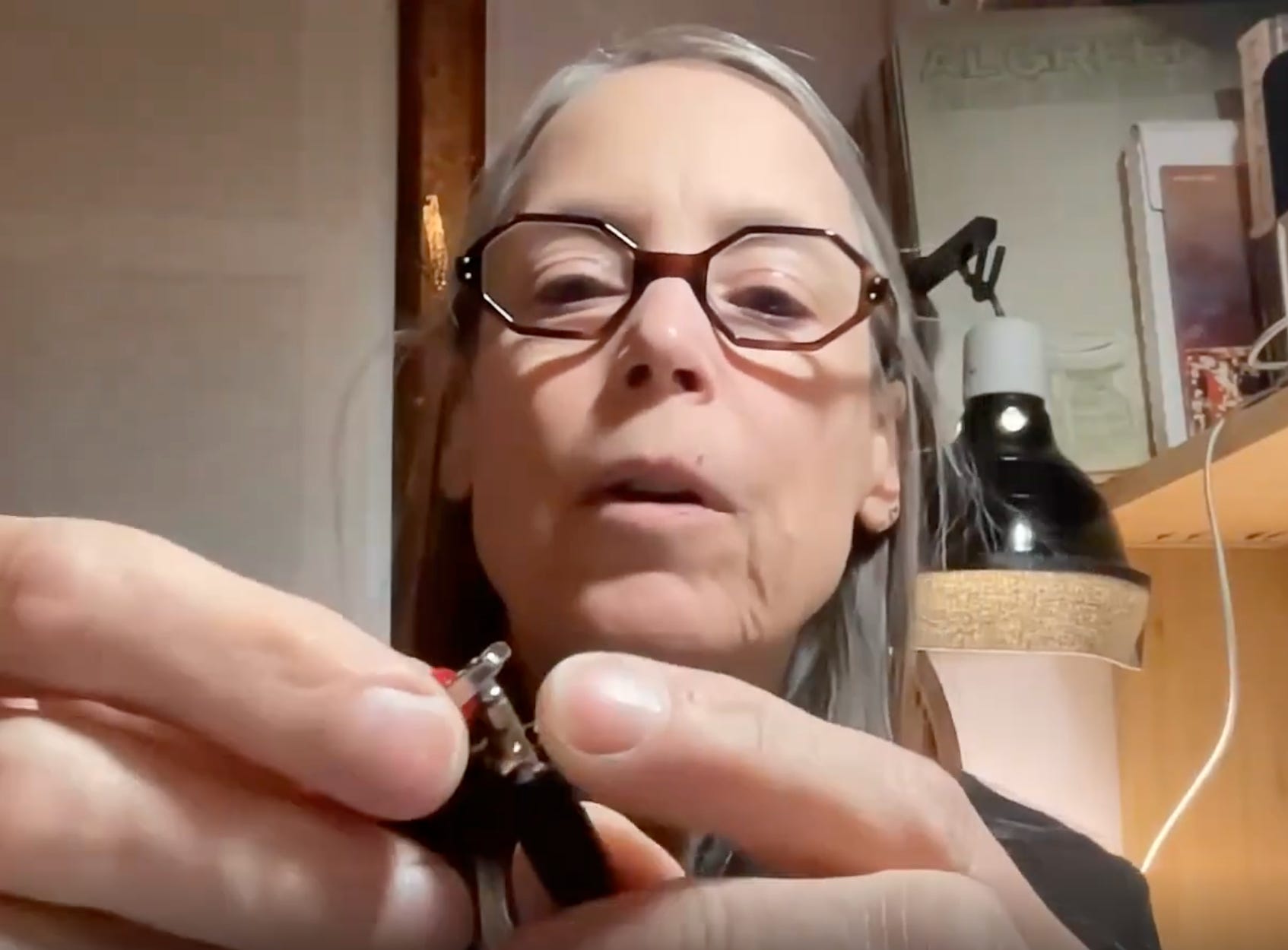
Kate Yourke begins with a series of demonstrations, noting that they lead up to the same scientific knowledge. She briefly discusses the historical foundations of electricity and magnetism, mentioning Ben Franklin’s experiments with a kite and key, which established the concepts of positive and negative charge, a conductor, and a battery. She also references Hans Christian Ørsted’s discovery that an electrical current creates a magnetic field.
Here is the video of the workshop, which was hosted by Godwyn Morris. A written overview follows.
Demonstrations and Projects
Ampère’s Law Demo: Kate shows a small copper pipe with compasses underneath to demonstrate that running electricity through the pipe creates a magnetic field, causing the compasses to move when the wire is connected and disconnected. She explains that the fundamental idea that electricity and magnetism are two sides of the same force is the theme for the series.
Motor/Generator Concept: The speaker explains that any motor can be turned into a generator because the movement of a magnetic field will inspire the movement of electrons in a circuit.
Homopolar Motor (Faraday’s Motor): Kate discusses a simpler homopolar motor, which only has one coil. She explains that an electromagnet’s north and south poles can be swapped by changing the direction of the electrical flow. This is used to create motion through the interaction between the electromagnet’s magnetic field and a permanent magnet’s field. She shows sculptures made of copper wire and a battery with magnets, describing the process as a short circuit that creates a magnetic field around the wire, which then interacts with the permanent magnets to get a push and break the circuit. Flipping the magnets over will cause the motor to turn in the opposite direction. She suggests using 18 or 20 gauge uninsulated copper wire for this project.
Types of Speakers: Kate moves on to speakers, establishing that electricity running through a series of loops in a circuit creates a stronger magnetic field. She details the process of how a microphone records sound waves (vibrations) as an alternating electrical current. When this audio file is sent back through the speaker’s voice coil, it creates a changing magnetic field that interacts with a permanent magnet, pushing the diaphragm to recreate the original sound waves.
Cup Speaker: The classic cup speaker is made with a wound coil of magnet wire, an audio plug, a permanent magnet in the center, and a cup. She notes that magnet wire is a fine wire with a ceramic insulation, and she prefers 30 gauge for ease of use. Kate demonstrates winding the coil around a marker and gluing it to the bottom of the cup, ensuring the magnet will fit inside. She shows how to strip the ceramic coating off the ends of the magnet wire, ideally by burning it off and then lightly sanding it. Finally, she demonstrates connecting the wires to the audio plug’s casing and ground. Strong neodymium magnets are recommended.
Flat Speakers: Kate shows flat speaker versions made of copper foil cut into spirals using a digital cutter (Cricut or Silhouette Cameo) and stuck to an index card. She also demonstrates a version using aluminum foil, cut by hand and glued to card stock. She suggests using alligator clips to connect the wire coil to an audio cable if an audio plug is unavailable.
Embroidered Speakers (E-Textiles): An example is shown where conductive thread is embroidered in a spiral pattern on fabric using a computerized sewing machine, citing the Turtle Stitch program.
Kate recommends doing the speaker project in two sessions, allowing time for review of the scientific principles and troubleshooting. The homopolar motors can be done in 30 minutes.
Suggested Supply List for Projects
Here’s a list of parts for the above projects.
Audio + Electronics
Audio source with 3.5mm (headphone) jack
Audio cable or audio plug
Strong magnets (neodymium preferred)
Alligator clips
Conductive Materials / Coils (any one of these)
Aluminum foil
Copper tape (4” or wider if using vinyl cutter)
Copper foil
Magnet wire
Insulated wire
Bare wire
Conductive thread
Tools
Wire strippers (for insulated wire)
Lighter, sandpaper, or sharp knife (for removing magnet-wire enamel)
Speaker Cone Materials
Cardstock or index cards
Paper cups, bowls, or plates
Adhesives + Assembly
Electrical tape, masking tape, or shrink tubing
Hot glue, glue dots, or foam tape
to add a note I missed: the most likely point of failure for the magnet wire speaker is not removing the insulation well enough from the ends of the magnet wire. Allow time to correct any issues!