

Have computers lost their magic in class?
Do they cause more harm than good? Or are they just not the answer?

There was a time when a philanthropic group that funded education in the 2010’s had an iconic photo on their annual report. The photo was a young person, usually a young black girl, sitting in front of computer screen and smiling. It was meant to signal that giving minorities access to computers and computer-based learning would close the digital divide and achievement gap at the same time. It was a hopeful time, and technology seemed to offer a breakthrough opportunity to improve education for all students. Here was this tool, a combination of hardware, software and connectivity, that would give students access to better ways to learn and make up for inconsistent quality of teaching. They’d be immersed in digital learning environments.

How times change. Long after One-Laptop-Per-Child and an EdTech industry that produced all kinds of gamified educational software, and since Covid when Chromebooks in schools became ubiquitous, there’s a move on to remove laptops from classrooms and reduce screen time in and out of school. Students on computers aren’t really learning, we had hoped; they’re lost.
I remember an educator saying many years ago that by introducing computers into schools, students would come to feel about computers the way they felt about books. Books lost their magic when assigned in class. So now have computers, perhaps. Computers were once outside the education system and promised a way to disrupt it. Now computers have been fully absorbed by the system, and no longer challenge it.
Also, being on a computer is not at all novel to a student today, as it once was. Like electric lighting, it’s just normal. Increasingly, parents and teachers see that screens are now a big source of distraction — part of the problem and not the solution.
The Atlantic’s What Happened After a Teacher Ditched Screens by Jenny Anderson profiles a seventh grade teacher, Dylan Kane. He was once a pioneer and proponent of technology use in the classroom but one day decided to stop having his kids do work on their Chromebooks. He recognized that
he was spending precious minutes managing the transition to and from screens, reconnecting to the internet, troubleshooting the inevitable problems: the charger that wouldn’t work, the software that inexplicably blocked the wrong websites, the Chromebook that was suddenly dead. “You might be amazed at how much time I spend dealing with stuff like that,” he said.
Kane wondered if computers were doing more harm than good, so he tried to run his classroom for a month without Chromebooks.
Not only did he lose less time futzing over lost chargers and bad links, but he also noticed right away that his students paid more attention to what he said. Even more striking, Kane found that it was easier to connect with and respond to his students.
The biggest problem with students having Chromebooks was how difficult it was to get the attention of students as a teacher and have them participate in discussions.
“There’s this gravity that the screens exert on student attention,” he told me. “They’re waiting for it to unpause, waiting for it to pull them back in.”
Kane could no longer tell what students were doing, if anything, but just mindlessly staring at the screen. Or off in social media or playing video games. He wanted to pull them back into the classroom. After he removed the Chromebooks for a month, he realized that he didn’t need the computers in class anymore.
Not only did he lose less time futzing over lost chargers and bad links, but he also noticed right away that his students paid more attention to what he said. Even more striking, Kane found that it was easier to connect with and respond to his students.
One of the reasons that technology hasn’t proven to be a game changer in education has a lot to do with a student motivation. An unmotivated student sitting at a computer with assignments to do has even more opportunities for distraction, and a decrease in focus and engagement. “Screens offered students cover, a way to appear engaged without any actual sustained effort,” wrote Anderson.
It’s not the computer; it’s AI
Listen to Joe Liemandt, the principal of Alpha School and the founder of Trilogy Software and ESW Capital on the podcast The Knowledge Project.
Liemandt talks about learning as though you hit a fast-forward button and learn at a ten-times rate — the Commander Data School of Speed Reading.
Liemandt has made “a $1 billion bet that AI can make kids learn ten times faster, and that school as we know it isn’t just inefficient, it’s broken.”
At Alpha School, students spend two hours a day on AI-driven instruction and score in the top 1% on standardized tests. The rest of the day is devoted to what Liemandt calls life skills: leadership, entrepreneurship, teamwork, and real projects that kids actually care about.
Liemandt is thoughtful and his arguments are compelling but they take the form of a pitch. Alpha School says that students can learn academics in two hours a day and that promise is alluring, even exciting. Think of all that wasted time in school! The bargain it seeks to strike with students is if you can get through the academics, you have the rest of the day to explore, experiment and do projects of your own. However, separating academics and enrichment may not be the right idea. It’s the classic “eat your vegetables and then you get dessert.” Why can’t academics and enrichment be integrated as in project-based learning?
Alpha School’s AI keeps track of whether kids are paying attention on the computer and they give feedback on whether the student is wasting time. Their new version of gamification is that kids who pay attention and finish their schoolwork are given time to do other things they like, and it’s reflected in the name of their AI platform “Timeback.” Isn’t it a bit like punching into a clock? The system is keeping track of your work.
Alpha School’s promise echoes how private schools market to parents — without questioning it — that kids who do well on academics will do well in life (because they will get into a good college.) For all of its talk of disruption, Alpha School accepts at face value that the academic curriculum is what’s really important about school, even as AI itself is challenging the value of this curriculum as well as the outcomes produced by a college education.
The AI magic that makes all this happen is new and parents who are looking to give their already motivated kids an extra advantage will pay for it. But is it really the answer for all those kids who aren’t particularly motivated and struggle in school? Does getting students to score in the top 1% on standardized tests really mean that this what learning should be about?
Social Context of Learning
Coming back to Dylan Kane who removed the Chromebooks from class into order to restore student’s ability to focus and interact with the teacher and participate in class discussion. Removing computers doesn’t necessarily mean a return to textbooks and worksheets.
Education, Kane knows, is profoundly and stubbornly social. “There are a lot of students who need accountability,” he said. The answer is not more surveillance, but more companionship in the struggle. “Students benefit from being in a room with a bunch of other people who are learning the same thing, the collective effervescence of all trying to make progress together,” he said. “And they benefit from an adult who knows them, who is in the room, who says ‘I care about your learning.’”
This is why makerspaces in school matter. They offer a purposeful way to integrate technology and learning in a “stubbornly” social context, bringing students together to work (and play). Technology assists them in creating and inventing but the magic is in the interactions among students and teachers as well as among students themselves, not the tools. Students are not sitting isolated on computers; they are having a social experience while learning with others.
Will AI one day be seen, like computers once were, as an upgrade from teachers? That would be a mistake. As is said about using AI, education needs “humans in the loop,” not outside it. The challenge is how to create the educational context where those adults can be even more impactful in working with students in school.
I am at the ASU-GSV Summit in San Diego this week, finishing up this post which I began last week. Today, I visited The San Diego Met, a Big Picture Learning School, which is a small, public high school. The San Diego Met, which has 125 students, organizes advisory periods for students first thing in the morning. The goal of advisory is get students to talk about academic and personal growth, explore teamwork and community building skills.
I sat in on one group of 15 juniors who sat in a circle on couches and comfortable chairs — the students remain in the same advisory group for all four years. Their advisor, a science teacher, asked them to answer a rather silly question such as “When you eat a brownie, do you want a crusty piece from the edge or a soft, chewy piece from the center?” The students laughed and each of them gave an answer. It was one of several questions, mainly to get students to speak up and also listen to each other.
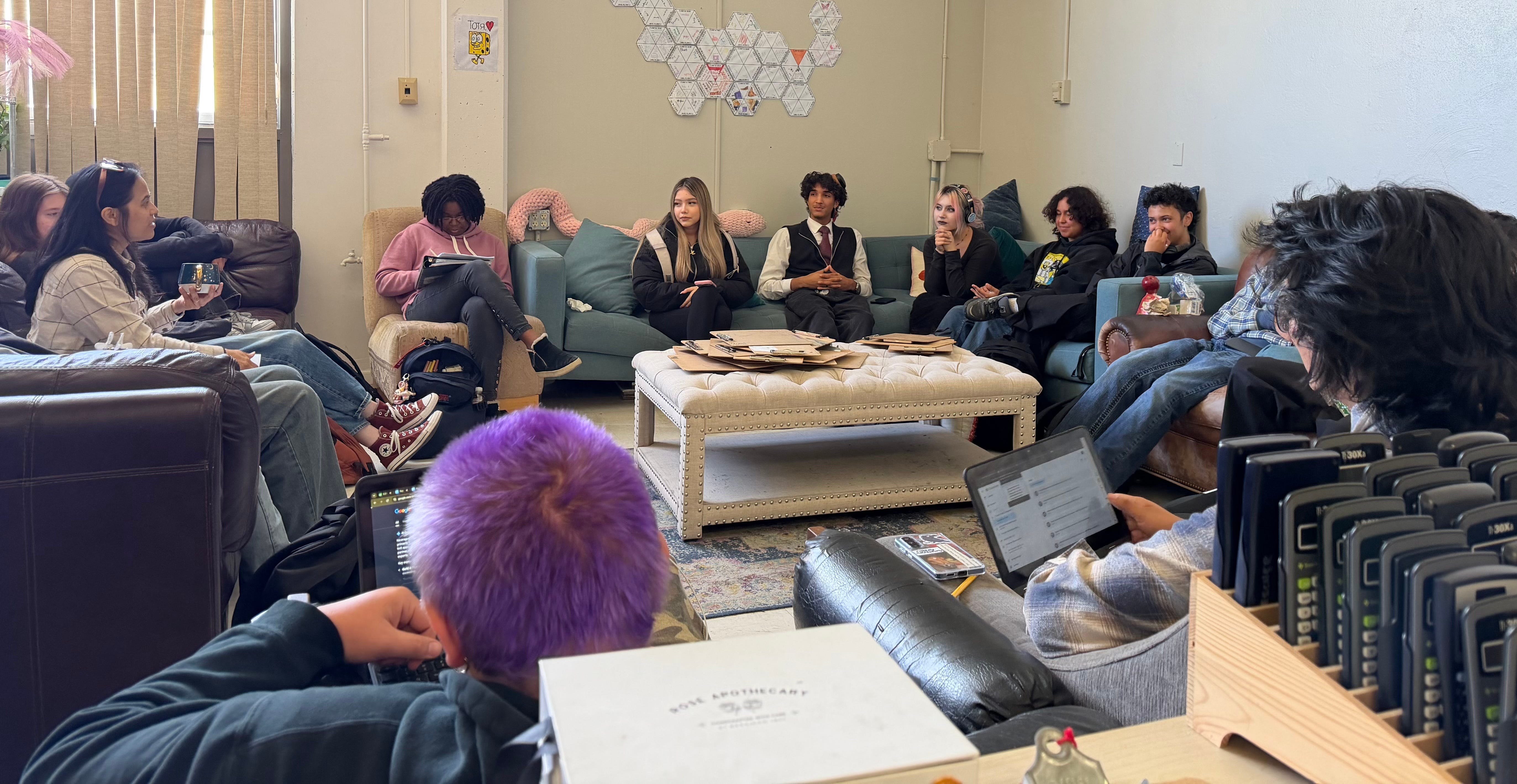
Afterwards, the teacher asked them to talk about advisory. “I love hearing people’s opinions,” said one of them. Another said that advisory was a warm-up for the rest of the day. They seemed to genuinely enjoy each other’s company — even as some of them had screens open.
I saw that a teacher and a group of students came together and found “companionship in the struggle” to learn and grow as humans. That seemed like magic to me.