


It started with a linocut: a three-eyed cat with an open mouth and a lot of carved lines. I began with a sketch, transferred the image to lino, carved it by hand, rolled ink onto the block, and printed it on paper. It is an old graphic technique in which every action has consequences. Once you cut something away, you cannot simply put it back.
Then I became curious about what would happen if I took the same image into a completely different process. The two-dimensional print became the starting point for a three-dimensional object. The three eyes needed volume, the mouth had to become an actual opening, and the carved lines suggesting fur had to be translated into texture and relief. New questions appeared that did not exist in the original print. What does this cat look like from the side? How does the head connect to the body? What happens at the back, a part of the image I had never designed? Eventually, the linocut became a digital 3D model, ready to be printed.
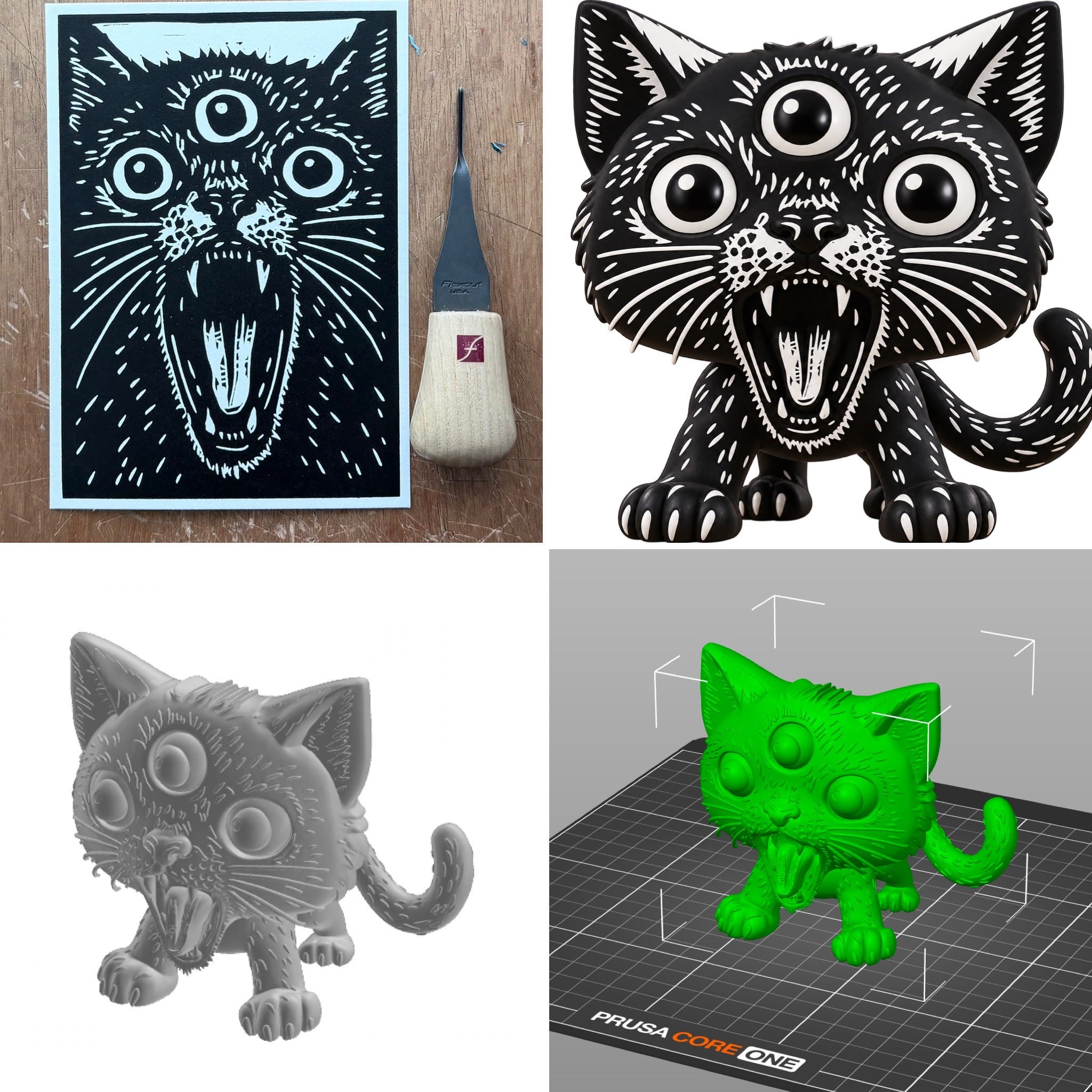
At first, this sounds like a journey from an old craft to new technology. I am becoming less interested in that distinction. A carving tool and a 3D printer are very different tools, yet both force a maker to turn an idea into something physical. What changes is the way you have to think while making.
With linocut, you work directly with material and resistance. You feel the carving tool moving through the lino and have to think ahead because every cut is permanent. You learn about line, contrast, positive and negative space, while the material keeps interfering with your intentions. A line becomes wider than expected, a small piece breaks away, or the first print reveals that an area does not work the way you imagined. These are not necessarily failures. They become part of the conversation between maker and material.
3D modeling and printing demand a different kind of thinking. Digitally, you can go back, resize, duplicate, undo, and try again. That freedom can make the process seem less demanding, yet the physical world eventually returns. A wall may be too thin to print, parts need to connect, and an overhang may need support. Something that looks convincing on a screen may turn out to be weak, awkward, or impossible to print. The printer does not simply reproduce an idea; it introduces another set of limitations that the maker has to understand and respond to.
This is where the combination becomes valuable for maker education. If students learn linocut and 3D printing as two separate techniques, both can easily become exercises in learning how to use tools. If the same idea has to travel through both processes, something more interesting happens: students have to translate.
A line on paper has no thickness, and a printed figure has no backside. A white area in a linocut could become a hole, a recess, or a raised surface in a 3D model. The original image does not provide those answers, so students have to make decisions. They are no longer reproducing an image; they are interpreting their own work.
That is an important distinction. Learning to operate a 3D printer is useful, just as learning to handle a carving tool safely and skillfully is useful. Maker education becomes more meaningful when those technical skills are needed to solve a problem the student actually owns. The technology is no longer the assignment. It becomes part of the thinking.
Traditional craft also deserves a different place in contemporary education. Linocut is not valuable simply because it is old, handmade, or somehow more authentic than digital work. Its value lies in what the process demands from the maker. It slows you down, makes decisions visible, and introduces resistance and consequences. You cannot endlessly undo your way back to an earlier version, and you have to work with what the material gives you.
Digital fabrication offers something equally valuable. It allows an idea to move beyond the limitations of the original material and makes iteration, transformation, scaling, and reproduction possible in entirely different ways. Students can test a form, discover that it does not work, change the model, and print another version. The ease of changing something does not remove the need to think; it changes the kind of thinking that is required.
Put the two together and students encounter two very different relationships with making. Linocut asks them to commit, while digital modeling encourages iteration. One removes material, while the other builds it up layer by layer. One begins with a flat surface, while the other forces students to think about volume, structure, balance, and space. Neither needs to replace the other, because their educational value lies partly in the differences between them.
This matters even more at a time when digital tools and AI can increasingly assist with parts of the creative process. The educational goal cannot simply be to produce a polished object as efficiently as possible. A finished object tells us very little about what someone has learned. More interesting evidence can be found in the decisions made along the way. Why did you change this shape? What happened when the material resisted your idea? What did the first print teach you? Which part did you have to redesign yourself? Being able to answer those questions makes ownership of the process visible.
From Print to Object in the Classroom
This idea can become a relatively simple classroom project. Students begin by developing a small image and translating it into a linocut. They make several sketches, choose one, and start thinking about line, shape, contrast, and positive and negative space. They then transfer the design to lino, carve it, and make a first print.
That first print should not automatically be treated as the finished result. It can be used as feedback. Students look closely at what actually happened. Some lines may have disappeared, areas may have filled with ink, or an accidental mark may have made the image more interesting. They can return to the block, make changes, and print again. In this way, even a centuries-old printing technique becomes an iterative design process.
The next stage begins before any 3D software is opened. Students place their print in front of them and draw what their object might look like from the side and from behind. This is an important moment because the original artwork stops providing answers. Students have to invent information that was never part of the two-dimensional image.
Only then do they start modeling. Their task is not to make an exact 3D copy of the linocut, because that is impossible. Their task is to decide what needs to change for the image to become an object. A line might become a ridge, a black area might become a solid volume, and a white area might become a recess or an opening. Students have to decide which characteristics of the original image are essential and which can change.
The model is then prepared for printing. Once again, the technology introduces new conditions. Students need to consider whether parts are thick enough, how the object will stand, where support may be necessary, and whether the form can actually be printed. The first physical print becomes another moment for observation and revision rather than simply a final product.
A failed print should not immediately disappear into the trash. It can be one of the most useful pieces of evidence in the project because it shows where an assumption met physical reality. Students can examine what went wrong, return to the model, make an adjustment, and try again. Failure then becomes visible as part of designing rather than something that has to be hidden at the end.
At the end of the project, the sketch, lino block, print, digital model, failed attempts, and final 3D print can all be placed next to one another. Instead of asking students only whether they are satisfied with the result, I would ask them what happened to their idea along the way. What could they do with lino that was difficult in 3D? What became possible only after moving into three dimensions? Which decision was forced by the material? Which mistake changed the work for the better? At what point did they feel most like the maker of the object?
The result is no longer a linocut lesson followed by a 3D-printing lesson. It becomes one continuous design process in which craft, digital technology, material, failure, and ownership are connected. My three-eyed cat started as lines carved into a piece of lino and is now becoming volume, texture, and a physical object I can hold in my hand. For me, that is where the educational value lies. Innovation does not have to mean replacing an old technique with a new one. It can also emerge when we allow old craft and new technology to influence each other, with the carving tool and the 3D printer sharing the same workbench.
