

Developing Maker Skills
Steph Piper's "Skill Seeker: Young Maker Edition" focuses on skill awareness

I’d argue that having a skillset is more valuable than a credential. Helping students develop skills and understand the value of them are core to the practice of maker education. The could be technical skills such as using CAD or writing code but they can also be life skills like communicating effectively. Awareness that you possess skills builds confidence.
Recently, Rob Henderson (on “X” and Substack) quoted Adam Carolla on Joe Rogan’s podcast.
“I realized that you have a skill set. Like martial arts. You know it, you’re comfortable with it, you’re secure in it. You know your abilities there, just like you know your abilities as a comedian or as an archer.
For me, I’m a carpenter. I have a skill, a trade. There are things I know well, so I don’t feel insecure. I know what I’m good at, and I’m grounded in that.
But a lot of people don’t have that. They don’t have a trade or a skill or anything they can honestly call expertise. If you asked them, ‘What are you an expert at?’ they wouldn’t have an answer. You could name several — UFC, mixed martial arts, jiu-jitsu, podcasting, standup, whatever it is.
You could learn another language or master an instrument. But so many people never find that thing. They never develop a skill they can own. And because of that, they walk around in this heightened state of insecurity.”
Henderson commented that “once you start getting good at something, and it can be almost anything, you can build from there. You now have something to talk about, something you know more about than most people. And if you can make it even mildly interesting, you can speak about it at length.”
In maker education, we might see a project as an expression of a bundle of skills, and the project gives students something to talk about. It’s not just what the project itself, but what the student learns along the way, and the skills they are developing.
Skill Seeker: Young Maker Edition
On Make:Live last week, I hosted a conversation with Australian Steph Piper on the launch of her new book, Skill Seeker: Young Maker Edition. We were joined by two maker educators, Daniel Ezell from California and Emma Ross from Australia.
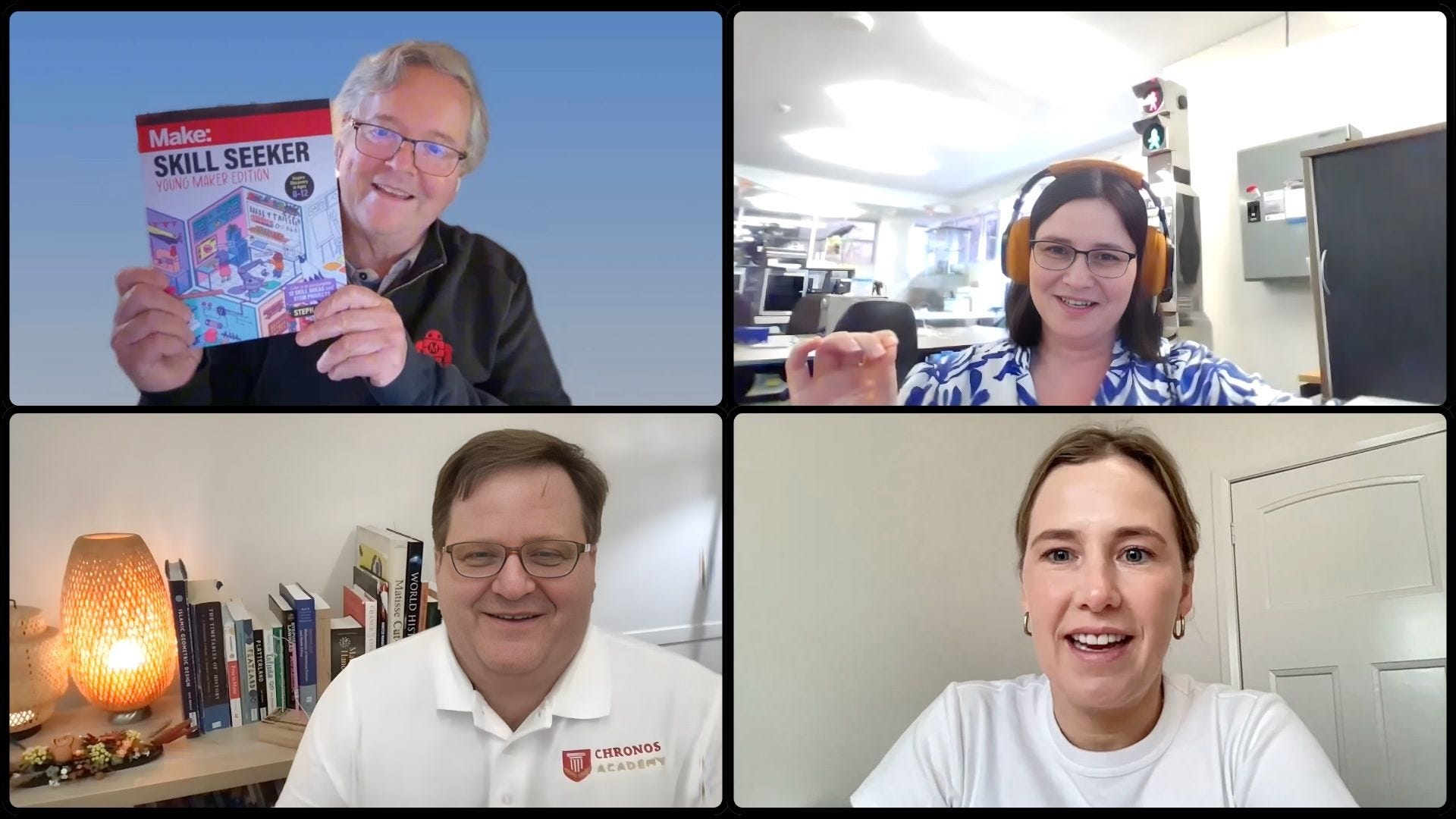
from top right clockwise - Steph Piper, Emma Cass, Daniel Ezell and me
“Skill trees” provide essential structure and guidance for ages 8–12, key developmental years in a young maker’s life. Steph’s system turns learning into a game that challenges kids without overwhelming them. The book covers 3D printing, vinyl cutting, electronics, crafting, robotics, and more. Parents, educators, and makerspace leaders can learn about why skill-building matters—and how kids can apply what they learn in the real world.
One of the key points in how conversation was how these skill trees can help make skill development visible for students, which also allows them to share a list of their skills with others. In Piper’s book, her skills dashboard does that, helping students become aware of their own skills and the skills of others around them.
Make: Live - Inspiring Young Makers with Steph Piper
Steph Piper, Maker Queen, is the Library Makerspace Manager at UniSQ, based in Toowoomba, Queensland, Australia. She is the author of two Skill Seeker books that help you track and level up your skills. She designs beautiful, multicolour circuit boards you can find on Etsy and crowdfunded GlowStitch, machine-sewable LEDs. She teaches 3D printing, 3D modeling, and Arduino classes, and has a background in biofabrication and 3D printing for medical-grade implants.
Daniel Ezell is the founder and curriculum director of Chronos Academy in Larkspur, CA. He is a long-time organizer of local Maker Camps.
Everybody should be young enough to take something apart and shoot it across the room with a handmade trebuchet. I, for one, revel in the opportunity to provoke creativity in young people today, helping more kids Make stuff, discover a math pattern or ask a question no one has ever thought of before.
Daniel Ezell
Emma Ross of The Maker Difference has experience across Victoria, Queensland, and the Northern Territory as a classroom teacher, leader, and consultant. She has worked closely with leadership teams and teachers to support STEM programs, establish Makerspaces, and deliver professional development focused on student voice.
Her passion for innovative education, along with a strong belief in the value of STEM programs and Makerspace learning environments, led her to complete a Master of Education and conduct case study research on Makerspaces. This work resulted in the creation of an evidence-based Makerspace Pedagogical Framework that is now used in schools.
Github for Skill Trees
While Steph and I both hope you buy her book to learn more about using Maker Skill Trees, you can also download the skill trees from her GitHub repository. There are over 70 skill trees, covering everything from coding and crochet to artificial intelligence.
Link: Maker Skill Trees
The book is available on Maker Shed: Skill Seeker: Young Maker Edition